
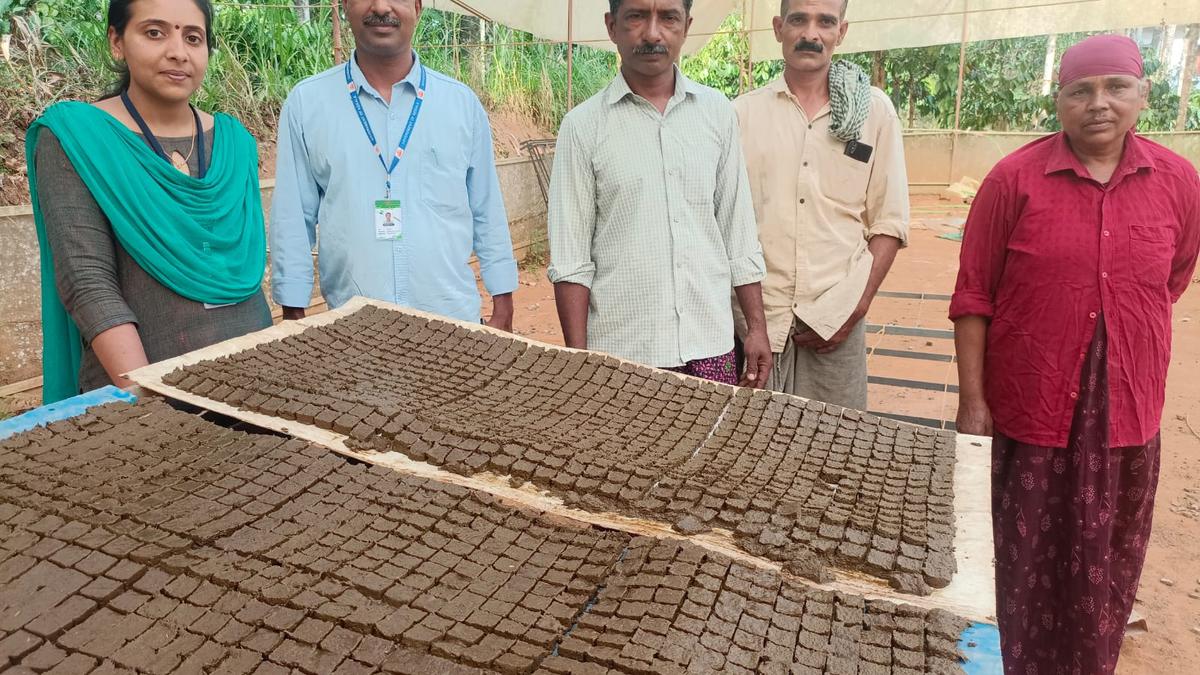
Aji Thomas (middle) who will showcase his unique rice farming at Rashtrapati Bhavan along with Agriculture department officials and workers at his nursery at Ambalavayal in Wayanad.
| Photo Credit: SPECIAL ARRANGEMENT
A farmer at Ambalavayal in Wayanad, Aji Thomas, will showcase his innovative rice cultivation method ketti natty or nenmeni chittunda at the Festival of Innovations and Entrepreneurship to be held at Rashtrapati Bhavan in New Delhi from April 10 to 13.
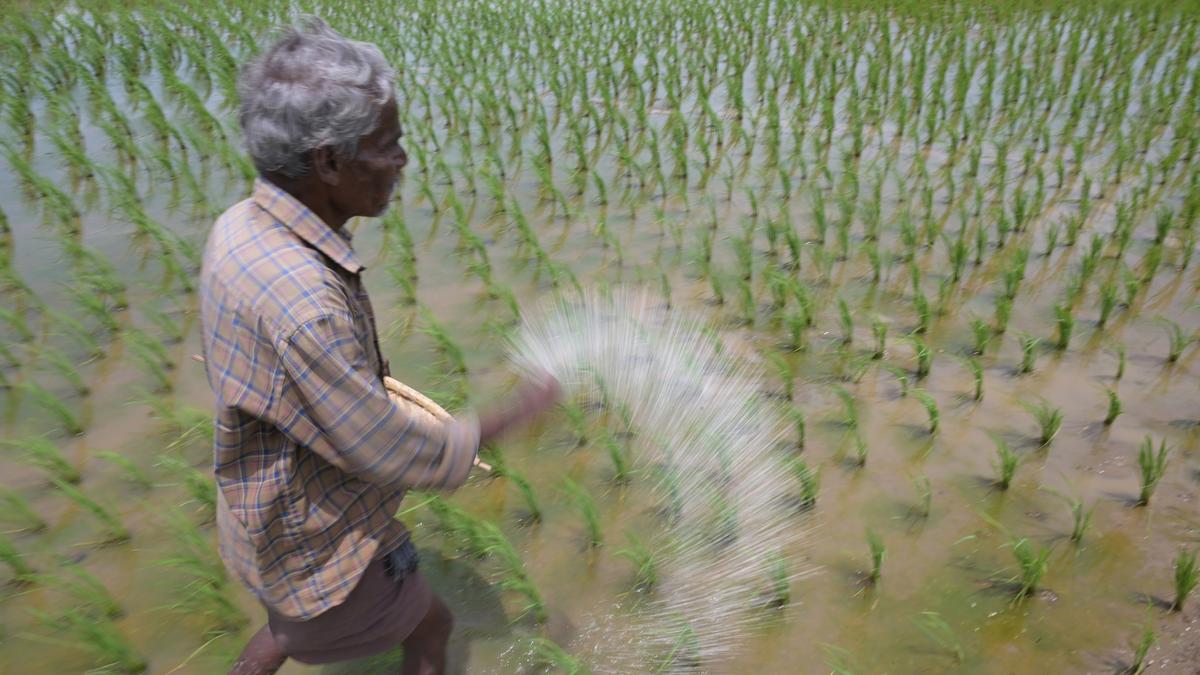
While many farmers have bid goodbye to rice cultivation owing to huge investment and low returns, Mr. Thomas, 49, developed the ‘bio-slurry pellet method of cultivation’ on his 40 cents around eight years ago.
Hundreds of farmers across the State are now following the innovative method, especially those following the organic way of cultivation.
Mr. Thomas uses a rubber mould with 64 holes to make pellets. Each hole is filled with 25 gm of bio-slurry mixture and panchagavya and one or two paddy seeds are inserted before it is set. Biocontrol agents such as pseudomonas and azospirillum are also added with a kg of bio-slurry to keep pathogens at bay.
“The pellets are placed in the field after germination at a distance of 25×25 cm. Rows are made so that the germinating plant gets ample air and sunlight. This method saves both time and money and there is no need to prepare a nursery for paddy plants,” says Mr. Thomas.
“The stress period of plants can be overcome under the method. Compared to the conventional rice cultivation method, it will help reduce the maturity period.”
“In the conventional nursery method, the crop takes approximately 160 days to mature while it takes only about 140 days if this technique is used. The average yield of rice from an acre is 1,000 to 1,200 kg. But under the new method, it has increased to 2,000 kg as the number of tiller from each plant is high. Many farmers have got 50 to 80 tillers from a plant, Close to 5 kg of rice seed is sufficient to plant one acre under the method,” he says.
“The number of manual labourers also has come down to six an acre as against 25, including for transplanting and weeding,” he says.
Mr. Thomas had won first prize for the method he developed at the rural innovators’ meet of the Kerala State Council for Science, Technology and Environment in 2017.