
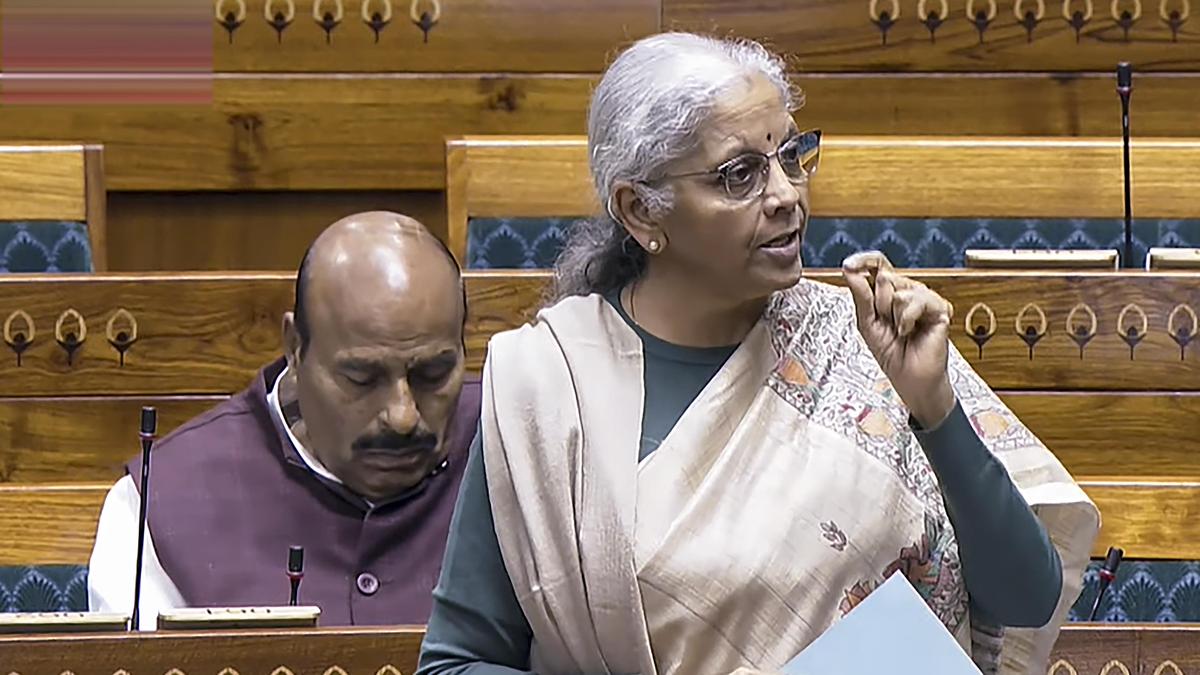
Union Finance Minister Nirmala Sitharaman speaks in the Lok Sabha during the Winter session of Parliament, in New Delhi, on December 3, 2025.
| Photo Credit: Sansad TV via PTI
Finance Minister Nirmala Sitharaman on Wednesday (December 3, 2025) said the levy of excise on tobacco will ensure that incidence of tax on the demerit good remains same even after the expiry of the GST compensation cess.
Moving the Central Excise (Amendment) Bill, 2025, for discussion and passage in the Lok Sabha, the Finance Minister said since the GST law caps maximum rate of tax at 40%, the ultimate tax incidence on tobacco after removal of GST cess would come down from the current level if excise duty is not levied.

“In order to ensure that the incidence is not lower than what it was during GST with the compensation cess, we are bringing this excise. In a way we are saying cigarettes should not become affordable now because incidence has become lesser,” the Minister said.
The bill proposes to replace the GST compensation cess which is currently levied on all tobacco products like cigarette, chewing tobacco, cigar, hookah, zarda, and scented tobacco. Currently, a 28% GST plus cess at varied rate is levied on tobacco.
The bill proposes to levy excise duty of 60-70% on unmanufactured tobacco. The excise duty on cigars and cheroots is proposed at 25% or ₹5,000 per 1,000 sticks, whichever is higher.
Cigarettes, not having filters, and of length not over 65 millimetres will attract duty of ₹2,700 per 1,000 sticks and ₹4,500 per 1,000 sticks for length over 65 millimetres but not exceeding 70 millimetres.
The Finance Minister further said the bill was necessary as the loan taken to meet the revenue loss of states during Covid will be repaid in a “couple of weeks”, post which the compensation cess will cease to exist.

“In another, probably, couple of weeks the loans will be completely repaid. The Centre, therefore, wants to make sure that the excise will come back to us so that we can levy the duty,” Ms. Sitharaman said.
At the time of the introduction of the GST on July 1, 2017, a compensation cess mechanism was put in place for 5 years till June 30, 2022, to make up for the revenue loss suffered by states on account of GST implementation.
The levy of compensation cess was later extended by 4 years till March 31, 2026, and the collection is being used to repay the ₹2.69 lakh crore loan that the Centre took to compensate states for the GST revenue loss during the Covid period.
Published – December 03, 2025 05:56 pm IST