
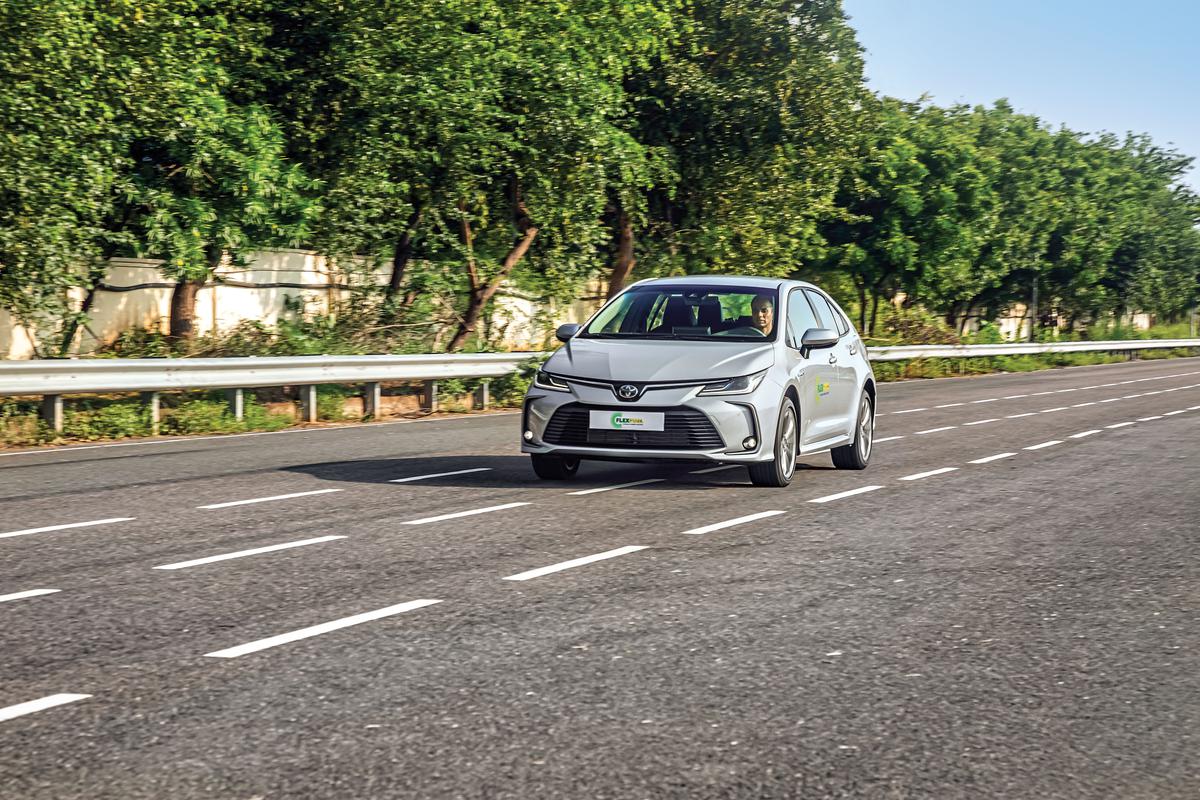
While the Union Minister for Road Transport and Highways, Nitin Gadkari, has been campaigning the use of flex-fuel vehicles, Toyota India has unveiled a flex-fuel Corolla hybrid.
The car, a left-hand-drive Corolla, is imported from Brazil — where the flex-fuel market is well developed — and is meant to bring attention to flex-fuel vehicles in India. While the 11th-generation Corolla was earlier sold here, there are no plans for now to introduce this current, 12th-generation model.
We were invited to a small drive at the International Centre for Automotive Technology’s (ICAT) test track in Manesar, and so here are a few brief impressions of the car’s engine and performance.
Under the hood of this Corolla is a flex-fuel-capable 1.8-litre petrol engine that makes 102hp and 142Nm of torque. It is coupled with a 72hp electric motor, which has a max torque of 163Nm, and is fed by a 1.3kWh battery that is continually charged on board. It is a typical strong hybrid system, just like in the Hyryder, which means, on a light foot, it can motor along on just electric mode. As soon as you demand some more, the engine kicks in, and while you can hear it, you do not really feel it coming in; the switching of power is seamless too.
What is different to Toyota’s SUV is the sprightly performance of the 1.8-litre engine, which is a welcome contrast to the dialled-down feel the Hyryder’s 1.5-litre engine delivers. The Corolla picks up pace quickly and acceleration is brisk all through. Out in the real world, it will deliver a strong highway performance. The gearbox is what Toyota calls an e-CVT, which essentially is a sun and planetary system, as in a traditional automatic, but it is set-up to provide infinite ratios.
Curiously, in the Hyryder — which also uses a similar set-up — the rubber band effect is present, which did not appear to be present in the Corolla. On the whole, the powertrain refinement is good and, all in all, the flex-fuel engine feels just like a regular petrol, which it essentially is. The only significant difference a flex-fuel vehicle owner will see against a regular petrol model is lower fuel efficiency, due to the lower energy density of ethanol.
That is where the Corolla’s strong hybrid system comes in. Like in the Hyryder, driven normally the car should motor along in EV mode for around 50 to 60% of the time, which more than compensates for the efficiency loss.
Design and interiors
Given that this car is not scheduled to launch in India, we focused our little time on the engine and stopped for only a bit to admire the new Corolla’s lines. Never being a fan of early Corolla styling, (it was only Altis that, to me, had some excitement), it was nice seeing that in the current car too. It reminds you of the Camry in a way, and the tipped forward stance, sleek headlights and aggressive bumper cuts add a nice touch of sportiness.
The inside is a more straightforward affair, devoid of any design flair and comes across as being built to be functional and comfortable, which it is. The multi-function steering wheel buttons are easy to use, as are the buttons and dials on the dashboard. The seats are nice and comfortable, and well-bolstered. Space was good, both in the front and rear, and after spending some time with the car, all we could think of was how it would do today in our market.
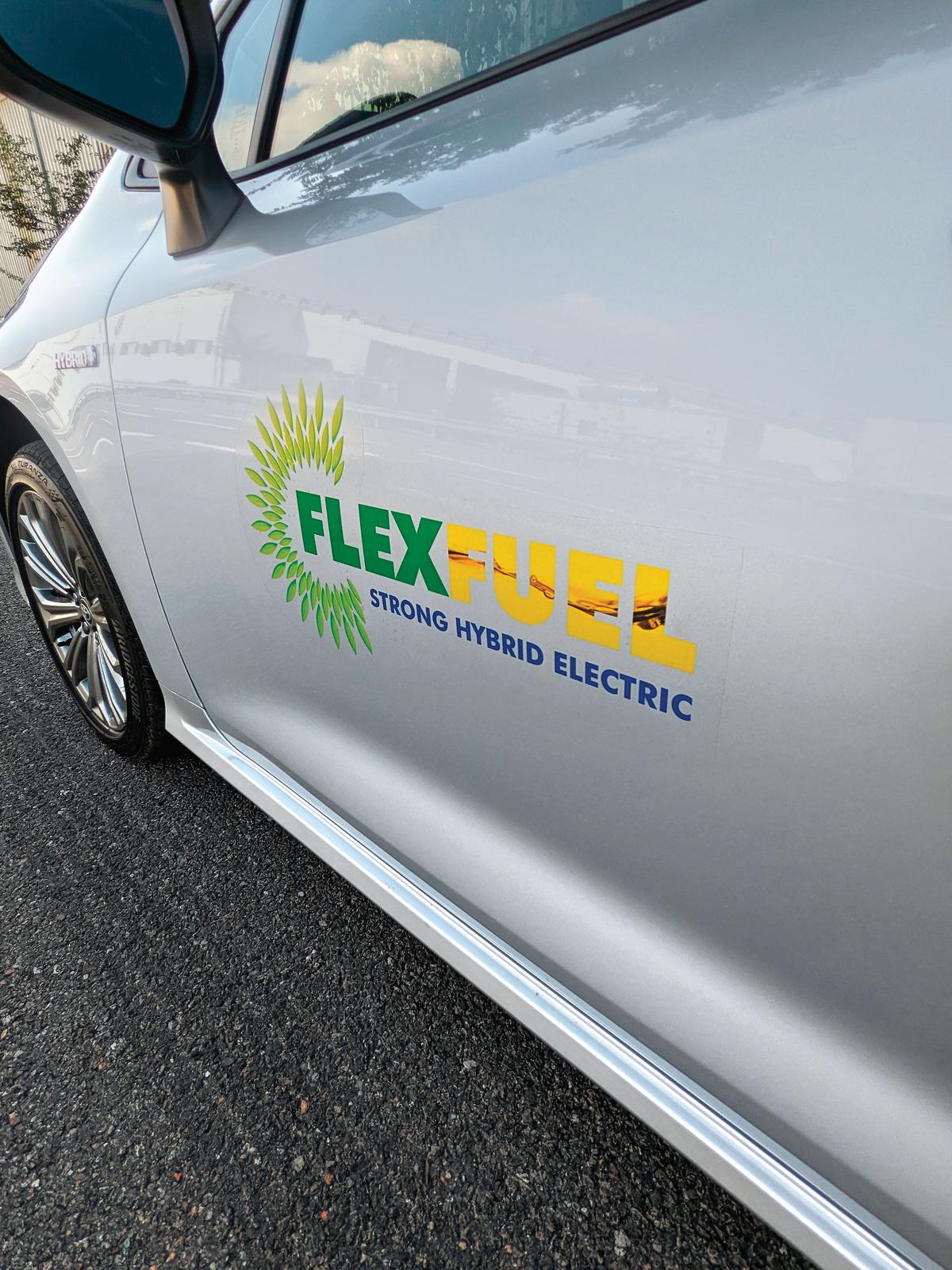
What is a flex-fuel vehicle and will it be sold in India?
Simply put, any internal combustion vehicle capable of running on a variable blend of fuels is called a flex-fuel vehicle. In this case, the Corolla can run on petrol and ethanol in any mix or even pure ethanol. In Brazil, the blend is 85% ethanol (E85), while here petrol currently supplied is mixed with 10% ethanol, which has no effect on an engine.
The Indian Government plans to increase the blend to 20% by next year, and this will require material changes to the fuel hoses to handle the corrosive nature of ethanol, as well as tuning and calibration to meet the emission norms and manage the lower energy density of the fuel.
Thus, when E20 fuel does arrive, all cars will have to be tweaked to manage it. However, there are no plans for now to launch a fully flex-fuel-capable vehicle in India. Toyota says, given that the technology is ready, if E85 or pure ethanol can be supplied across India, a truly flex-fuel vehicle could easily arrive here.