
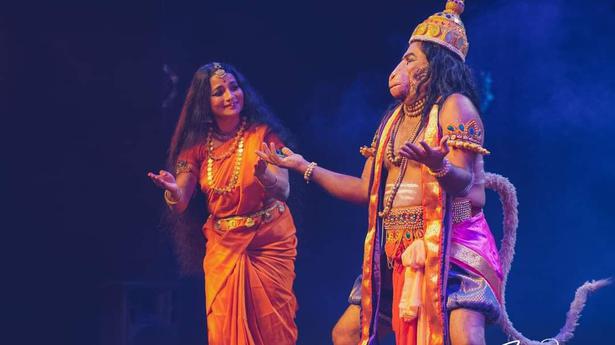
‘Anguliya Choodamani’, staged as part of Guru Gopinath’s birth anniversary celebration, showed how he had simplified Kathakali for a global appeal
‘Anguliya Choodamani’, staged as part of Guru Gopinath’s birth anniversary celebration, showed how he had simplified Kathakali for a global appeal
The avant-garde dancer Guru Gopinath (1908-1987) was an ambassador of Kathakali, who believed that the dance-theatre could be popularised only if it is staged in a manner intelligible to the common man. So he created an improvised version of Kathakali, which was originally known as Kathakali dance and later as Kerala Natanam. This was achieved by reducing the natyadharmi (stylised) elements in Kathakali and adding more lokadharmi (natural) abhinaya. In this pursuit, he was joined by his wife Thankamani, who was the first and only student of Mohiniyattam when the dance form was introduced in Kerala Kalamandalam in 1932.
Kalamandalam Madhavan, Kelu Nair and Ananda Sivaram, who were Gopinath’s contemporaries, popularised this style around the globe.
Guru Gopinath.
| Photo Credit: The Hindu Archives
A prolific choreographer, Gopinath’s works included 40 dance dramas apart from innumerable solos, duets, groups and folk dances, which were eloquent testimonies of his novel concept.
Though he was criticised for diluting Kathakali, it is his creations that inspired many artistes from across the world to learn Kathakali. Art lovers in Thiruvananthapuram got the rare opportunity to witness the dance drama ‘Anguliya Choodamani’ that was presented as part of the week-long birth anniversary celebrations at Guru Gopinath Natana Gramam.
Hanuman meets Sita
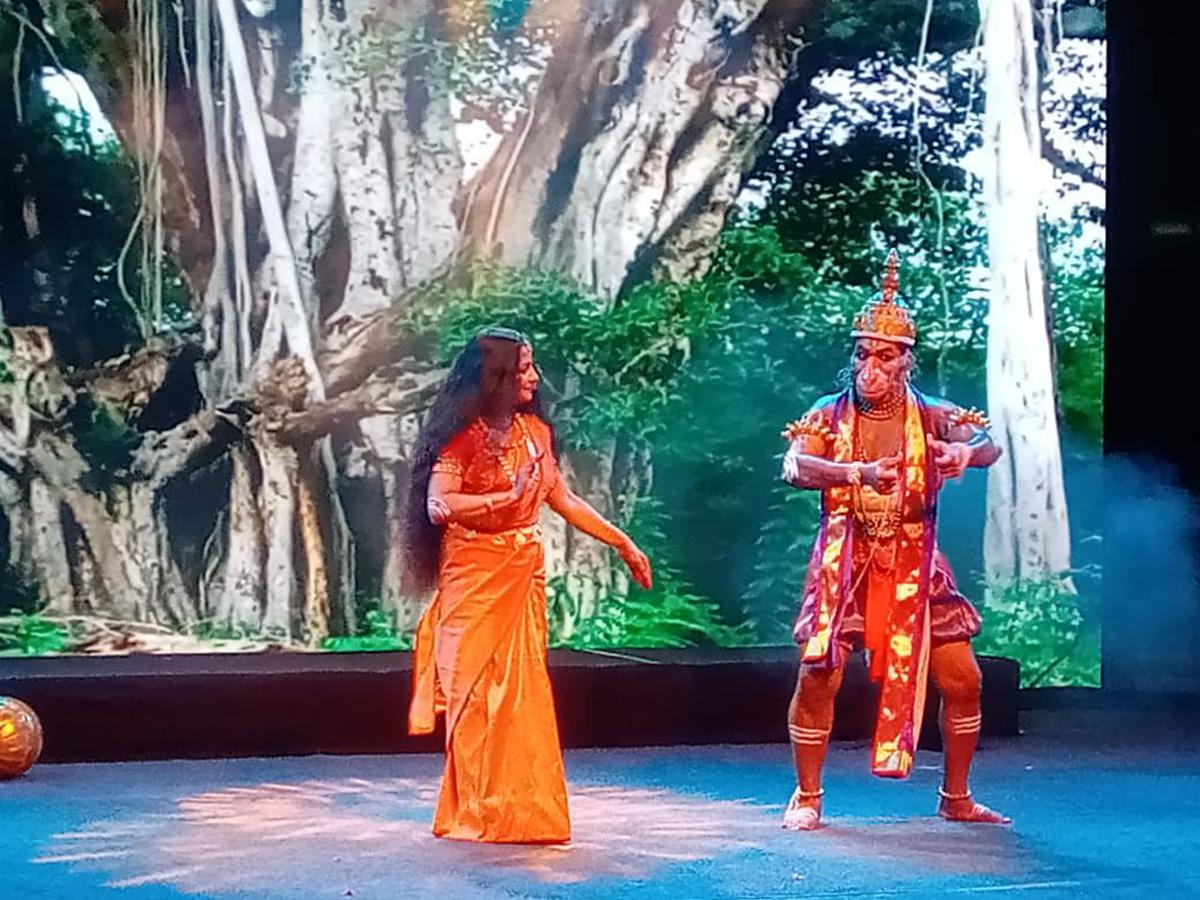
From ‘Anguliya Choodamani’.
| Photo Credit: Special Arrangement
Created in the 1950s, the leitmotif of the one-hour play is the meeting of Sita, abducted by Ravana, and Hanuman at Ashokvanika in Lanka. Hanuman presents Rama’s anguliya to Sita, and she in turn sends her choodamani to her beloved husband.
The 30-minute play was edited and recreated by Sajeev Nair. An engineer by profession, Sajeev is a disciple of Gopinath and has performed along with his guru on many stages.
Sajeev Nair.
| Photo Credit: Special Arrangement
The play opens with Sita’s thoughts about her pathetic plight. She is frightened by the environment around her. She wonders whether Rama has forgotten her completely and decides to take her life for which she tears a part of her cloth and throws it on a tree presumably for hanging herself.
All of a sudden she hears the chanting of ‘Rama, Rama’ and Hanuman appears on the scene, disguised with a mask on his face. The stranger’s presence further adds to her fear and she asks him to reveal his identity. At this point, he hands over Rama’s anguliya to her. Overjoyed to see the ring, she enquires about Rama and Hanuman gives a detailed description of his master.
Sita, in turn, sends her choodamani through Hanuman. His exultation is expressed through dance and finally, he disappears. Gopinath had choreographed the play in an ingenious way. Though the whole show was based on Kathakali, including music, kalasams and mudras, lokadharmi aspects, especially in the role of Sita, were very effective in communication. As for her aharya (costumes), she was clad in a saffron-coloured saree. Her movements were also not much stylised.
Aharya for each character
Incidentally, Gopinath always prescribed aharya for each character as in real life, unlike in Kathakali. A king was attired in the costume of a real king, and a hunter in a real hunter’s dress. This he had prescribed for Kerala Natanam, but distressingly once the dance form was introduced in the youth festivals, it took a form very similar to Mohiniyattam. This has been criticised by scholars.
Hanuman’s mudras, kalasam and ilakiattam were strictly in the Kathakali format. Music composed by the late V. Dakshinamoorthy was on the lines of pure Kathakali sangeetham in ragamalika and talamalika. Hanuman’s verses were excerpted from Kamba Ramayanam (Tamil). The LED screen on the backstage depicting the Ashokvanika was a laudable innovation by Sajeev Nair; it added to the theatrical effect.
Sajeev, who portrayed Hanuman, proved he is a well-trained Kathakali artiste. He was proud that the mask he used was fabricated by Guru Chandrasekaran, a disciple of Gopinath. As for Sithara Balakrishnan, a seasoned Mohiniyattam dancer, the character of Sita demonstrated her commendable histrionic prowess.
The writer and culture critic is a trained musician.