
As Kochi city was just about resuming its usual hubbub during the early hours of September 23, 2025, a band of men in formal wear exited their vehicles outside the residence of film actor Dulquer Salman at Elamkulam in Kochi.
Around the same time, similar scenes unfolded at multiple locations across the city in front of the houses of prominent movie stars, high-net-worth individuals, including industrialists, celebrities, and social media influencers.
Team visited the houses of actor Prithiviraj at Thevara and actor Amit Chakkalackal at Kaloor. All three locations, within a five-kilometre radius, became focal points of a sweeping crackdown that was rapidly gaining momentum.
It emerged that a Statewide operation codenamed “Numkhor,” meaning “vehicle” in the Bhutanese language, was under way. The target of the crackdown, which was carried out by the Customs (Preventive) Commissionerate, Kochi, was the high-value pre-owned luxury cars reportedly smuggled into Kerala from Bhutan. Lending muscle to the operation were the Anti-Terrorist Squad, the Motor Vehicles department, and the Kerala Police.
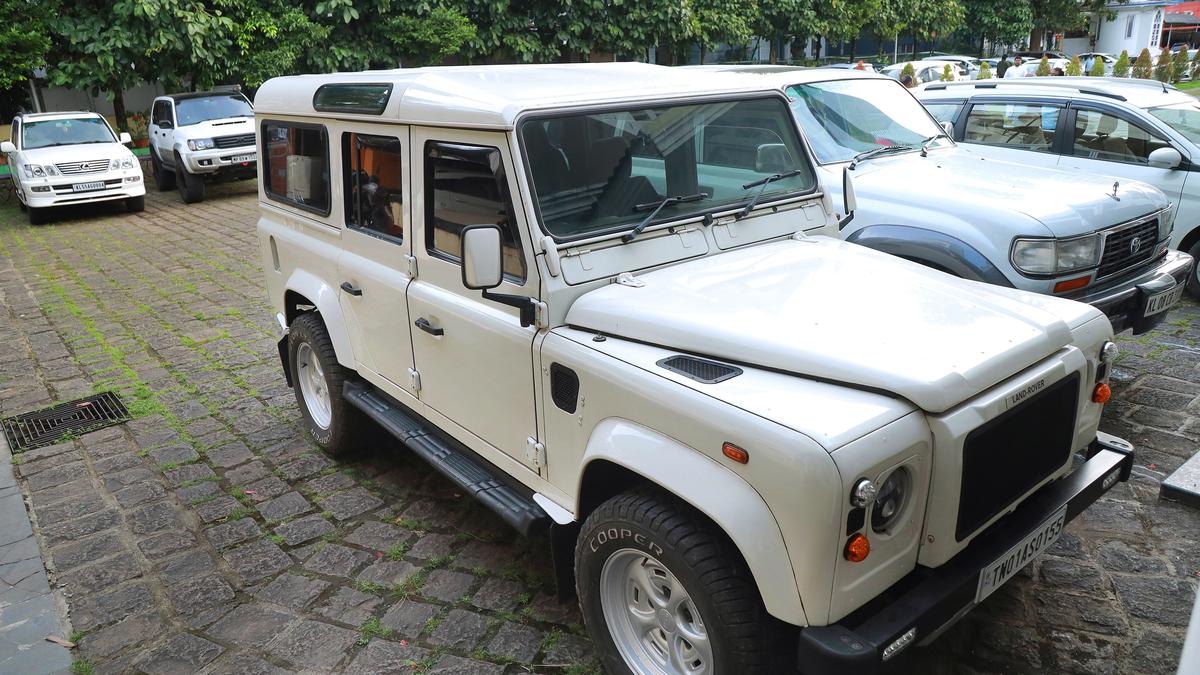
By the end of the day-long raids, the Customs had confiscated 37 premium vehicles. Among them were a Defender registered in the name of Dulquer and a Land Cruiser owned by Amit. Dulquer has since approached the Kerala High Court seeking the release of his vehicle, which, according to him, was a legally owned one.
150 to 200 vehicles
However, these vehicles, suspects T. Tiju, Commissioner of the Customs (Preventive) Commissionerate, Kochi, are among the 150 to 200 vehicles illegally brought in from Bhutan by a Coimbatore-based group over the past couple of years. The list was compiled by the Customs over the past six months, based on inputs from the Union Ministry of Road Transport and Highways, claimed the official at a media briefing.
The next day, two Land Cruisers were confiscated from garages at Adimaly in Idukki district and Kundannoor in Kochi. Soon, a Nissan Patrol, also registered in the name of Dulquer, was seized from the apartment of a person close to him at Vennala in Kochi.
Social media influencer Shilpa Surendran, whose vehicle was seized from Adimaly, was in a state of shock over the loss of her car, which she claimed to have purchased from a Tirur-based person for ₹15 lakh. She claimed to have spent another ₹5 lakh on it for its restoration. “Losing one’s life’s savings invested in a long-cherished dream is deeply painful. How am I supposed to know it was registered in India using forged documents? It is entirely the government’s responsibility to prevent fraudulent registrations,” she argues.
Customs officials inspect luxury cars at a garage in Kochi.
| Photo Credit:
R.K. Nithin
According to her, the previous owner, who acquired the vehicle from Karnataka, registered it in Kerala following a no-objection certificate (NOC) issued by the Regional Transport Office there.
Arunachal Pradesh registration
The vehicle seized from Kundannoor was found registered in the name of the original owner, whereas the others were reportedly registered in the names of subsequent owners. Bearing an Arunachal Pradesh registration, the Land Cruiser was registered in the name of a resident from Muvattupuzha in Ernakulam.
“All these cars were likely smuggled in through three methods — in a completely knocked-down condition, concealed within containers, or driven across the Indo-Bhutan border using permits issued to tourists travelling to India,” says Tiju.
The porous Indo-Bhutan border and Bhutan’s low import duty regime are believed to have attracted the smugglers to take this route, according to Customs officials. They also suspect that these vehicles might have been used for trafficking gold, narcotics, and other contraband.
Central agencies, such as the Directorate of Revenue Intelligence, had uncovered such instances and registered cases, raising concerns about national and economic security, says Tiju.
“If gold and drugs could have been trafficked using these vehicles, then virtually anything could be smuggled in,” says Tiju, while not entirely dismissing the possibility that proceeds from the smuggling may have been used to fund terrorism.
Forged seal, insignia
The racket behind the suspected smuggling was found to have forged the name, seal, and insignia of the Indian Army, the Indian and American Embassies, and the Ministry of Foreign Affairs for registering the smuggled vehicles locally and misleading buyers into believing that these were official vehicles of these agencies, according to Customs officials.
The Customs officials have found that nearly 90% of these vehicles were registered using forged documents, primarily at Regional Transport Offices in other States, before being transported to Coimbatore and then sold across the country. They have not ruled out the possible collusion of MVD officials in these States. Even the Parivahan website, hosted by the Ministry of Road Transport & Highways, is suspected to have been manipulated by the racket for facilitating the illegal activities.
For instance, a vehicle manufactured in 2014 was discovered to have been registered under the name of its first user as early as 2005. The verification of the Vehicle Identification Number (chassis number) by the original registration authority could have immediately exposed the racket, observes a senior MVD official.
“Had the original registration authority in India verified the chassis number of the vehicles, it would have immediately revealed that the vehicle originated in Bhutan and was unlawfully imported or smuggled. The failure to do so suggests either negligence or collusion,” says the official on condition of anonymity.
The Customs has warned that many such smuggled vehicles, registered through fraudulent means in other parts of the country and not yet registered in Kerala, may be operating on roads here without a valid fitness certificate or insurance. If these vehicles are involved in criminal activities or accidents, tracing the actual owner could prove a tough task, they fear.
Importing pre-owned cars is not permissible, except under the provisions of the Transfer of Residence (TR). In such cases, a vehicle that has been used for not less than three years in the country of origin may be brought into India and registered here after paying an import duty of 160% subject to the condition that it will not be sold for five years since its registration in India, points out Customs officials.
“Vehicles suspected to have been smuggled into Bhutan are mostly classic models manufactured between 1970 and 1990. Till the second half of 2000, when foreign vehicles could be bought directly from showrooms here, foreign vehicles could be registered in India only through TR or by purchasing them at auction by the State Trading Corporation, to which foreign embassies sold their used vehicles. The solemn responsibility of such vehicles rests with the original owner and the original registration authority, which obviously glosses over documentation endorsement in the passport, Customs clearance permit, certificate of duty payment, etc,” says Upendra Narayanan, expert member of the State Road Safety Authority.
He called for modernising the Motor Vehicles department and arming it with the most modern equipment for better enforcement. As it is, the department and its ways are at least half a century behind compared to the enforcement methods of advanced countries, says Narayanan.
‘Likely to be scrapped’
M. Jithesh Menon, a lawyer, notes that these vehicles, which reportedly originated outside India, cannot be run on Indian roads, as they were registered using forged documents. As the registration of these vehicles is illegal, any subsequent sale would be treated as void, and the vehicles may have to be eventually scrapped, he feels.
The Customs has asked all the owners of the confiscated vehicles to produce the documents related to them. Failure to comply with the directive could lead to legal action, including possible arrest under the Customs Act, they warn.
It’s suspected that many individuals who purchased these vehicles lack both a verifiable money trail and supporting documents, says Tiju.
Amit points out that when vehicles change ownership, subsequent buyers may not always retain all the records that the original owner had possessed. Even officials from the Motor Vehicles department are uncertain about the database before the launch of the Parivahan portal. The actor suggests that it would be beneficial if the government prioritises access to such documents in the event of an emergency.
Besides asking for the documents of the vehicles owned by him, the Customs has asked Amit to provide records for six other vehicles seized from a garage in his neighbourhood. By his own admission, those vehicles were brought to the garage for restoration on his recommendation.
With “Operation Numkhor” receiving widespread attention, tracking down the remaining vehicles suspected of being brought to Kerala may prove challenging, as there is a possibility that their current owners are either concealing them or disposing of them, says a police official.
Press meet with a difference
The media briefing of the Customs Commissioner on the crackdown too had its share of twists and turns, which took even the Customs officials by surprise.
The Customs Commissioner abruptly ended the press conference after answering a phone call, which he received midway through the media briefing. A visibly unsettled Commissioner, responding in monosyllables—mostly “sir”—left the press conference in a huff, giving room for doubts about the fate of the drive led by him.
The early morning crackdown and the subsequent developments, including the hasty cancellation of the media briefing before the full glare of TV channels, have left more questions unanswered. Is there more to it than meets the eye?