


[ad_1]
On the banks of the Bharathappuzha river, the rhythmic clatter of handlooms once echoed from almost every home in Kuthampully. This tiny village in Thrissur district, famed for its handwoven cottons and soft kasavu sarees with Geographical Indication (GI) tag, was once a bustling hub where buyers came from across the State and even from outside in search of authentic weaves.
Today, that music has almost fallen silent. In place of the humble, thatched huts that once sheltered looms, large concrete buildings and glittering textile showrooms now dominate the landscape. But most of these shops sell powerloom products masquerading as handloom, while the small weaving units with fading signboards struggle to be noticed.
“When I started weaving with my father, I was just 13. That was 56 years ago,” recalls Subramanyam, 70, a weaver from the Devanga Brahmin community, traditionally weavers, who migrated from Karnataka generations ago. “Back then, around 100 families of our community were weaving here. Later, even local communities and people from Tamil Nadu took up weaving. At its peak, Kuthampully had more than 1,500 looms. Nearby villages like Thiruvilwamala and Eravathody had hundreds more.”
A weaver at a handloom weaving unit at Kuthampully.
| Photo Credit:
K.K. NAJEEB
Now, only about 150 looms survive. The decline mirrors the story of traditional handloom across Kerala, shrinking earnings, lack of government support, and the overpowering rise of mechanised looms.
Meagre income
For the ageing weavers, the struggle is twofold — the craft is vanishing, and so is the interest of the younger generation. Mahendran, 58, a weaver with four and a half decades of experience, admits the dilemma: “My two sons are doing block printing for powerlooms. They don’t want to join me. How can I force them? Even after working from morning till evening, we earn only ₹300–400 a day. Will today’s youth be satisfied with that? With our generation, this occupation will die.”
The biggest challenge comes from powerlooms that produce cheaper product in greater variety. “A handloom saree takes 22,000 coordinated hand and foot movements. If the design is complex, it means even more strokes. Each piece carries painstaking labour. But powerlooms flood the market with cheaper, varied designs. Buyers often can’t tell the difference, and many settle for less when they see a lower price. We can’t compete with their rates,” P. Chandrasekhar, who runs a private weaving unit Supriya Weavers, explains the imbalance.
Value of authenticity
Yet, for connoisseurs who still value authenticity, handloom artisans continue to create. “We customise designs for those who truly appreciate handwoven fabric. But keeping up with fast-changing trends is a challenge in itself,” Mr. Chandrasekhar adds.
If market competition weren’t enough, financial bottlenecks cripple the sector further. Delays in government funds and unpaid dues from State-run outlets like Handex have pushed handloom cooperative societies into debt. A. Saravanan, secretary of the Kuthampully Cooperative Handloom Society, outlines the crisis: “Nearly ₹80 lakh of government funds are pending. Handex owes us ₹1 crore, and another ₹1 crore worth of weavers’ production insentives are stuck. To keep going, we borrowed ₹2.5 crore from Kerala Bank, but we now pay ₹30 lakh a year just as loan repayment.”
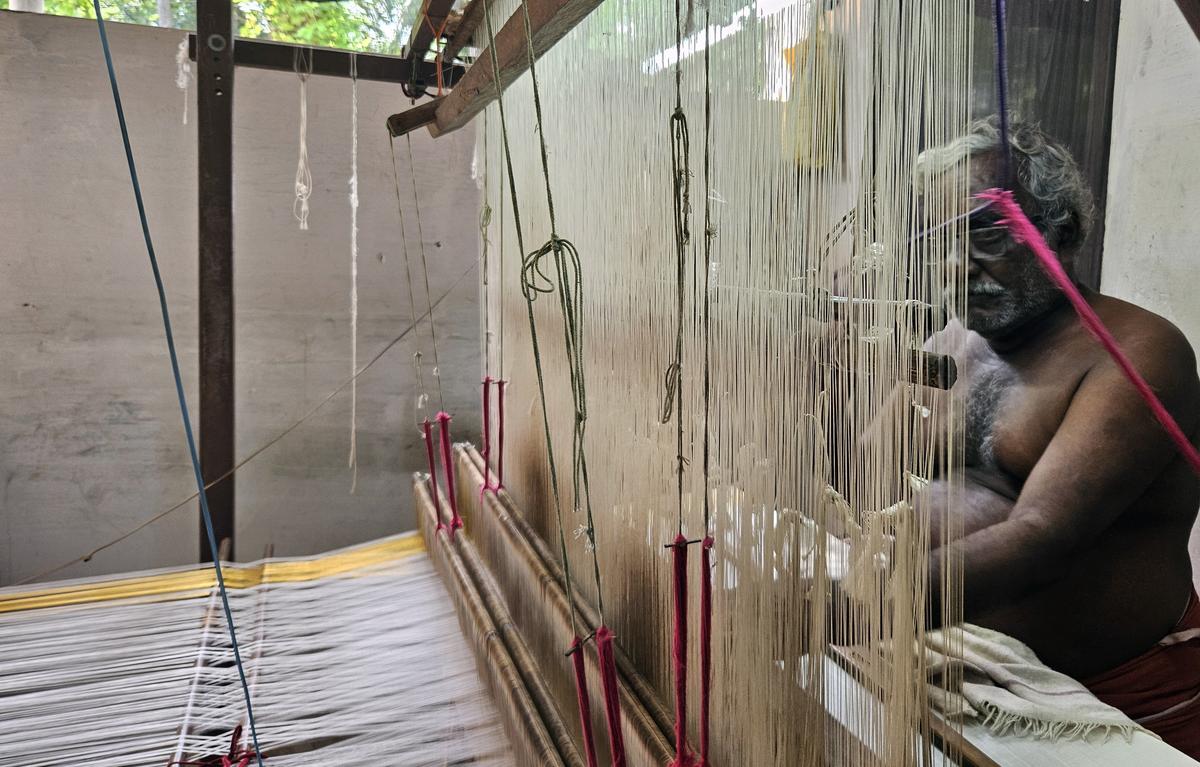
A weaver at a handloom weaving unit at Kuthampully.
| Photo Credit:
K.K. NAJEEB
Once one of Kerala’s most vibrant cooperatives with over 1,000 members, Kuthampully Cooperative society now has barely 50 active weavers. The societies in Thiruvilwamala and Eravathody have met the same fate.
The COVID-19 pandemic worsened matters. “It was a blow under the belt,” Mr. Saravanan says. “Raw materials became difficult to source, outlets shut down, and weavers stopped working. Many units closed permanently.”
Need for support, awareness
What remains today is a heritage gasping for breath. Weavers and experts alike agree that stronger government intervention and public awareness are key to revival. “Tamil Nadu offers wholehearted support to its weavers. Kerala must do the same if handloom is to survive here,” says Mr. Chandrasekhar.
He insists that the responsibility is not only with the State. “People too must realise this is not just a fabric, but a tradition and identity. Unless buyers make conscious choices, this craft will vanish. Only then can we protect this dying industry.”
From a village once alive with the music of looms to one dotted with deserted weaving rooms, Kuthampully’s journey tells a story of cultural loss. Whether its legacy survives the powerloom era depends on both policymakers and people and whether they choose preservation over convenience.
Published – September 02, 2025 04:30 pm IST
[ad_2]
Source link


