


[ad_1]
Every year on International Doctors’ Day, celebrated globally on July 1, the spotlight returns to the critical role of doctors in society. In India, where the number of NEET UG aspirants crossed over 24 lakh in 2025, this day also serves as a reminder of the aspirations of thousands who hope to wear the white coat but are unable to secure a medical seat due to limited opportunities at home.
With just over 1 lakh MBBS seats available across the country, many qualified candidates, despite competitive scores, find themselves without admission. For these students, studying medicine abroad has become more than an alternative.
This shift has given rise to a growing trend: Indian students migrating to countries like Russia, China, the Philippines, Georgia, and even further afield to generally popular study abroad destinations such as Canada, Australia, and the United States for medical education. While countries like the US, UK, and Australia host students in broader academic disciplines, a significant chunk of those heading to Eastern Europe and parts of Asia do so specifically to pursue MBBS-equivalent courses.
Where are Indian students going? What latest data from MEA says
According to data from the Ministry of External Affairs (MEA), as of January 1, 2024, over 11.6 lakh Indian students were studying in higher education institutions abroad. While this figure includes students across all streams, not just medicine, it offers valuable insight into the larger outbound education trend.
Here’s a country-specific overview of the top destinations we’ve observed starting in 2019:
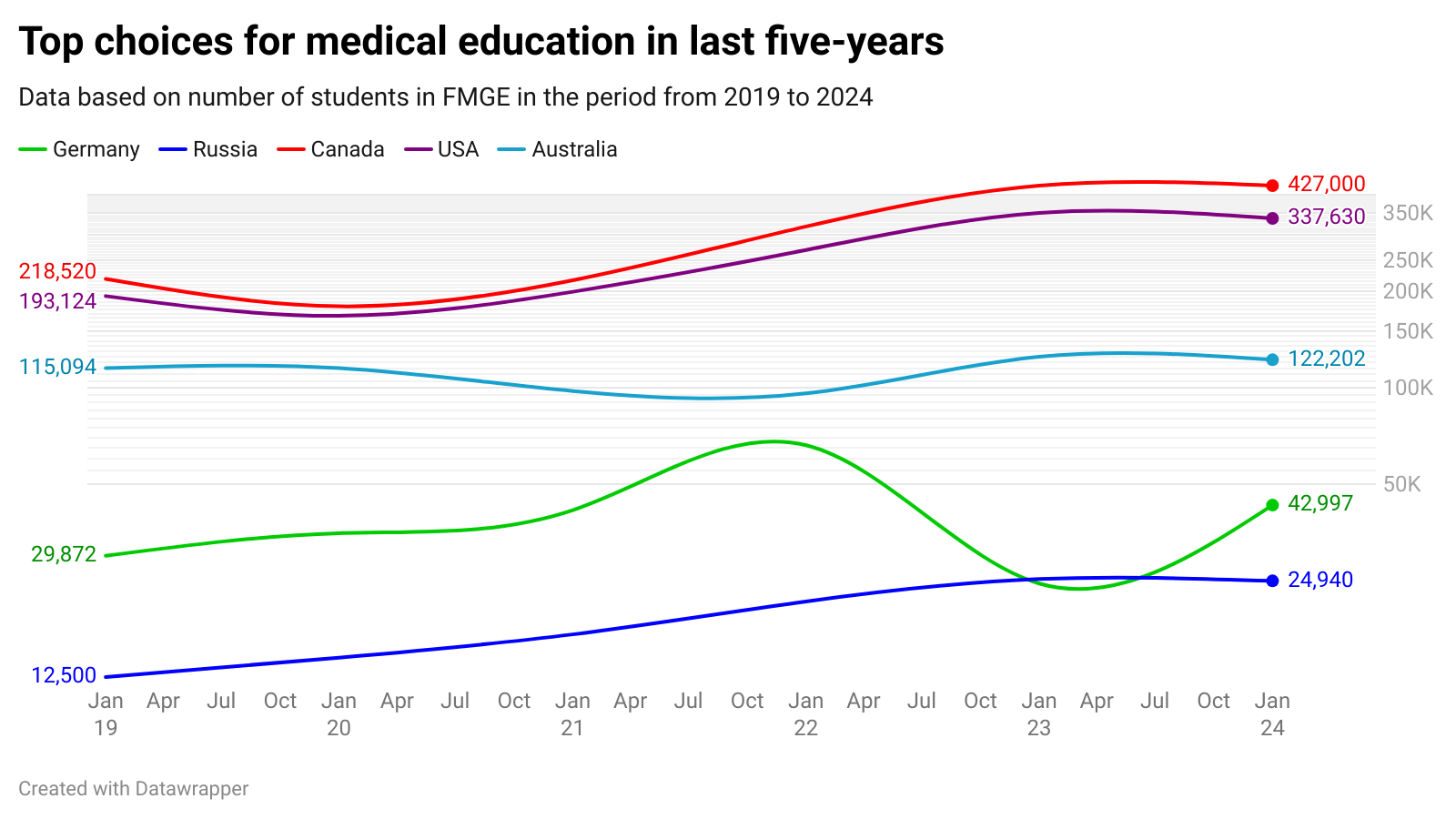 Top destinations in last five years (Source: MEA data from 2024)
Canada tops the list with 4.27 lakh students, largely in postgraduate and diploma programs followed by the United States with 3.37 lakh Indian students pursuing undergraduate, graduate, and professional courses.
Story continues below this ad
The UK hosts around 1.85 lakh, bolstered by streamlined post-study work visas.
Australia follows with 1.22 lakh, while Germany and Russia have around 42,997 and 24,940 Indian students respectively.
Although destinations like Canada and the US are known for broader education tracks including tech, management, and STEM, countries like Russia and Ukraine, with lower tuition and easy compliance with NEET eligibility, have become prominent destinations specifically for medical aspirants.
Which are the top medical education hubs Indian aspirants are flocking to?
Looking at the last five years of the outbound student movement, some interesting trends emerge. Countries like Canada and the US have shown steady increases in Indian enrolment post-pandemic. However, Russia, despite geopolitical instability, has maintained its popularity among MBBS aspirants due to low tuition fees and cultural support. The numbers, for instance, jumped from just over 12,500 in 2019 to nearly 25,000 in 2023.
National Doctors’ Day 2025: List of scholarship for MBBS aspirants
Story continues below this ad
Notably, Ukraine, which was once a top medical destination, has seen reduced enrolment since the 2022 war. Students are increasingly choosing Georgia, Kazakhstan, Kyrgyzstan, and the Philippines as emerging medical hubs. These destinations offer English-medium instruction and cost-effective MBBS programmes, often charged between Rs 15 and 35 lakh for the entire course.
FMGE Filter: How many made it back to India as doctors?
While going abroad may seem like an accessible solution, returning to India and practicing legally is not automatic. All foreign-trained medical graduates are required to clear the Foreign Medical Graduate Examination (FMGE) conducted by the National Board of Examinations (NBE). The exam acts as a screening test for granting provisional or permanent registration under the Medical Council of India.
Data from FMGE 2024 shows just how widespread Indian enrolment in foreign medical programs is. Here are the top countries based on number of candidates appearing for FMGE in 2024 –
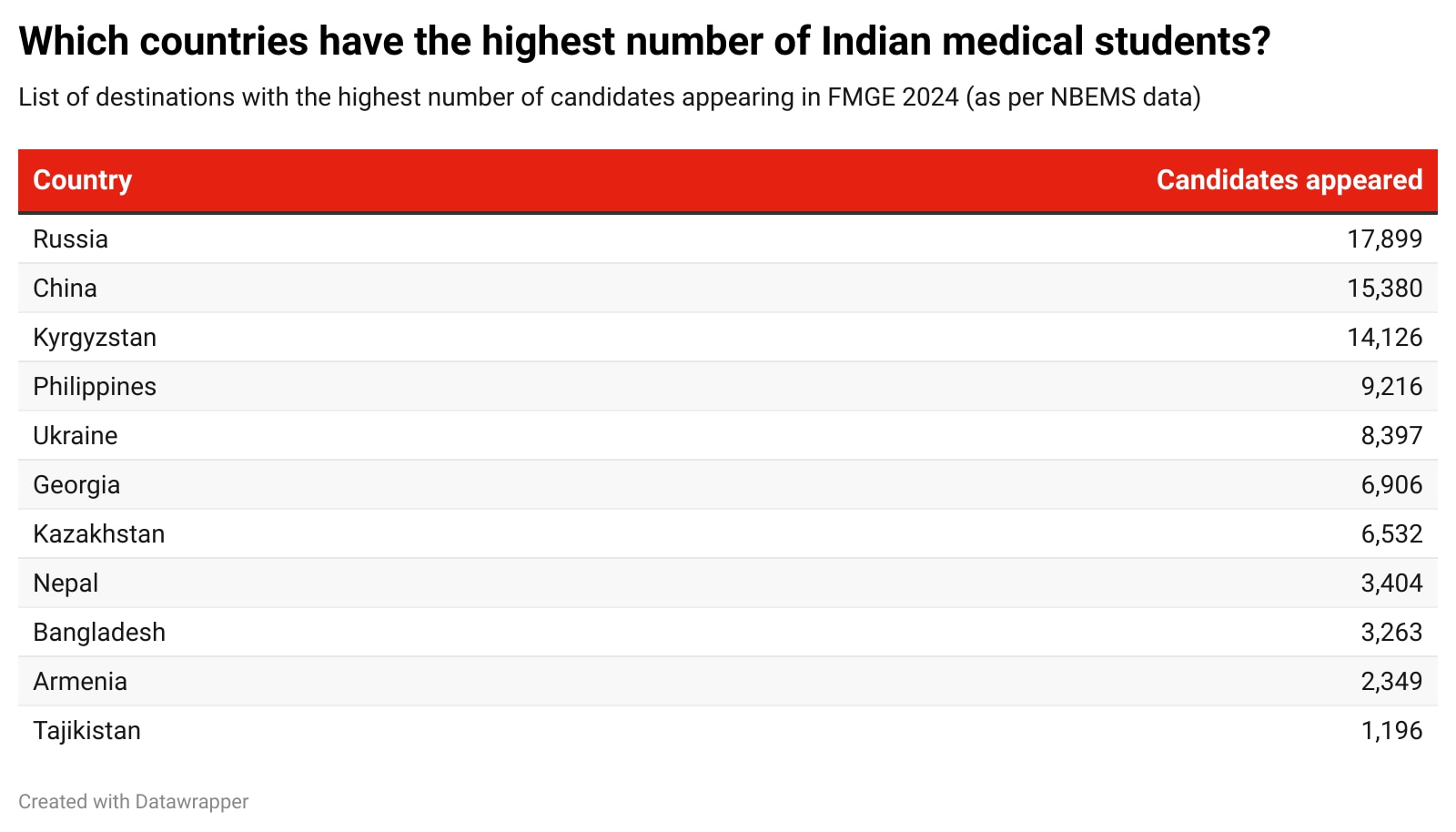 Countries with higher share of FMGE applicants (as per NBEMS data)
These numbers reflect not only the volume of medical students going abroad but also the challenging path to becoming a licensed practitioner in India. It would be worth noting that of the total 79,000 appearing in the FMGE 2024, only 20,382 qualified, recording a dismal pass-rate of 25.8% leading to many students struggle to clear the exam despite earning a degree abroad.
Story continues below this ad
Odisha govt to set up nine new medical colleges says Health and Family Welfare Minister
What drives an aspirants choice?
The allure of a medical degree coupled with limited seats in India has led students to weigh factors like cost, language, cultural compatibility, FMGE success rates, and post-graduation pathways. Countries like Bangladesh and Nepal are preferred for their curriculum similarity with Indian standards, leading to slightly better FMGE outcomes. In contrast, places like China and Kyrgyzstan continue to draw large numbers despite mixed exam performance data.
In an earlier interaction with the vice-chancellor of a leading medical institute in Russia, indianexpress.com learnt that the sustained interest of Indian students in Russian medical universities is driven by long-standing bilateral ties, cost advantages, and student-focused infrastructure. With Russian MBBS courses ranging between Rs 18 lakh and Rs 45 lakh, significantly lower than most private medical institutes in India, the affordability factor stands out. Additionally, universities provide tailored facilities for Indian students, including gender-specific hostels, Indian food, and cultural support units.
[ad_2]
Source link


